
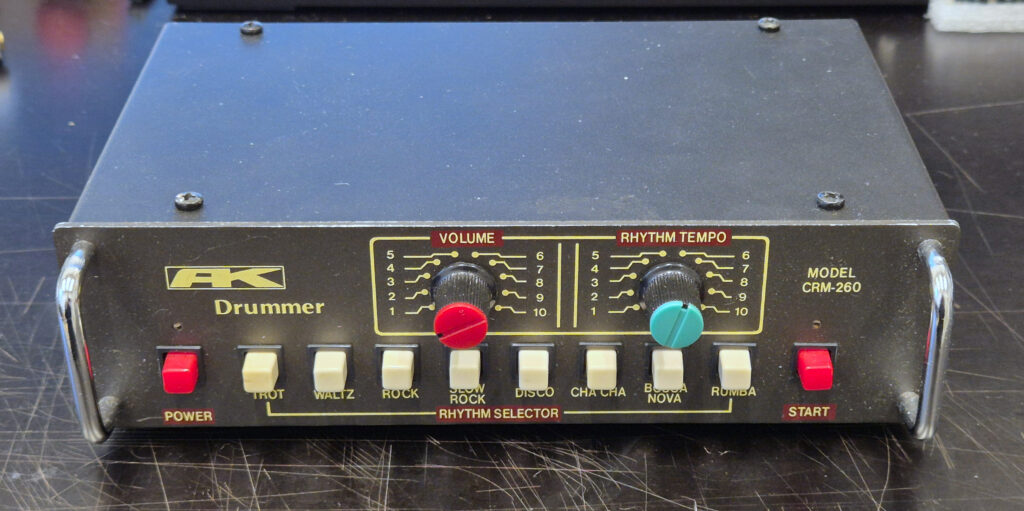
The drummer of our band MASCHIN KAPUT asked me if it was possible to modify one of his two cheap 1980s Korean preset rhythm boxes. He likes the Lofi sounds of his AK-Drummer CRM-260 rhythm machines, but wants it to produce more interesting rhythms. Knowing how analog drum machines work in principle and seeing the age on that one I gave an optimistic outlook. Shouldn’t this be as simple as just taking a microcontroller and injecting trigger signals at the right spot?
This is part 1 of a series of blog posts talking about the journey to teach this old machine new tricks.
First impressions
A 9V-powered drum machine with 8 different rhythms (plus one hidden one if you “unpress” all the buttons), a start/stop switch, a volume and a tempo knob. The rhythms are: Trot, Waltz, Slow Rock, Disco, Cha-Cha, Bossa Nova and Rumba. Typical for that generation of rhythm machines. The sound is absolutely rudimentary. Do I hear Twin-T resonators triggered by a pulse?
Doing my research
There isn’t much on to be found online on this drum machine, except for a series of youtube videos1 showing some working modifications without giving much details on how it was done. At least that indicates it is possible.
Since there are no real schematics or manuals to be found online I turned to the people from a friendly mailing list from whom I learned that this cheap rhythm machine was sold under many different names for example: Arista SM200, Supersound Drummer CRM-260, Conrad CRM-260, Cort Drummer CRM-260, Excel EX-1800 and our AK-Drummer CRM-2602.
Especially helpful was the advice of Benjamin Tremblay:
I never found a schematic. But the circuit is not hard to trace. The IC is a 4017, producing 6-8 step sequences. The kick drum and other drum circuits are very typical twin t circuits. The snare is just a tom tom sound, no white noise of its own. The hi-hat/shaker sound uses a coil like the Boss DR-55 to produce that whistling blue noise. In my experience with 2 of these machines there is a wide range of deviations between components and sound quality, and the trim pots are not enough to get things sounding nice. It’s a toy basically and the kick drum has no kick.
— Benjamin Tremblay
I don’t mind the sonic deficiencies Benjamin mentioned. It is a rudimentary machine in terms of sounds, but routed through the right kind of effects this can sound very interesting. Just not like a real drumkit or anything useful for a sleek techno production.
Another user (thanks to Edward) contributed something even more helpful, some basic schematics for the Artista SM200, which isn’t exactly the same machine, but looks suspiciously familiar from the outside:
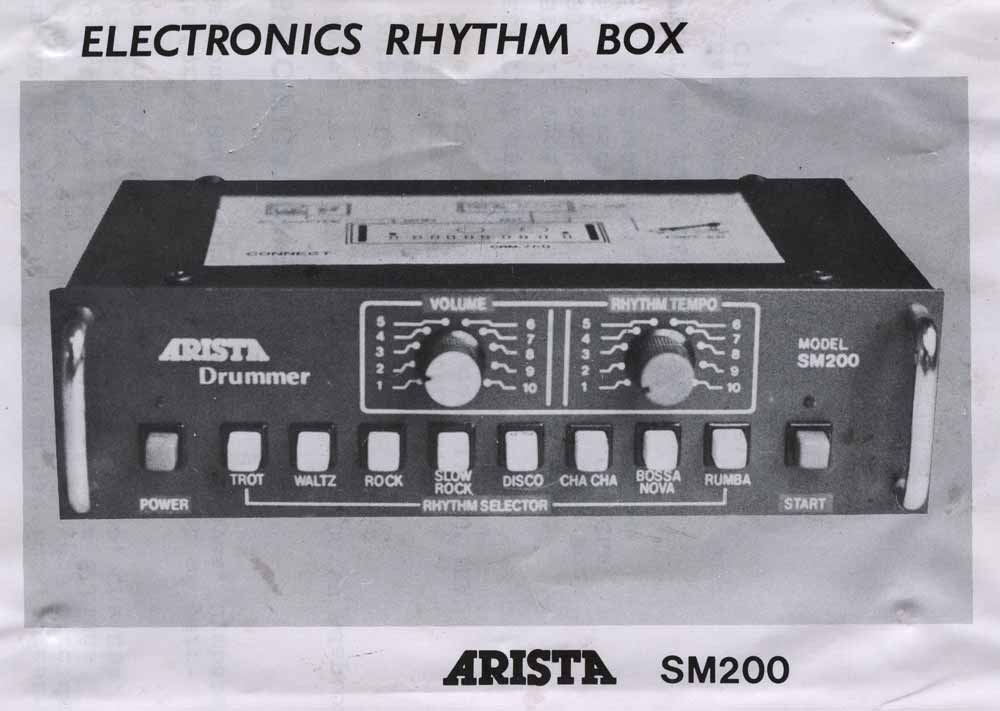
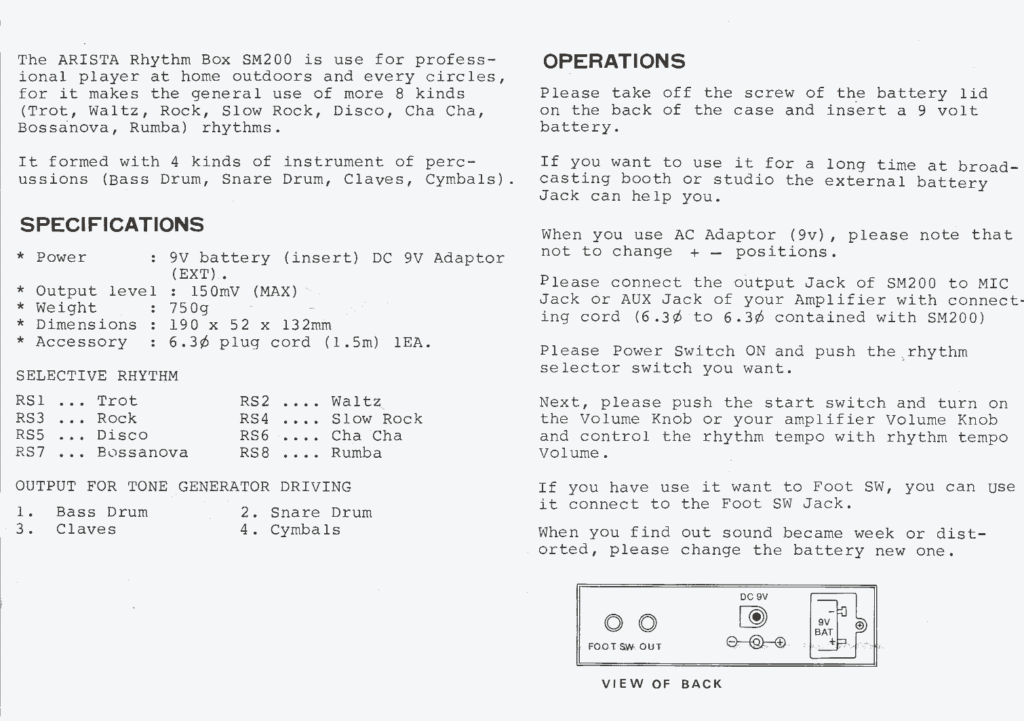
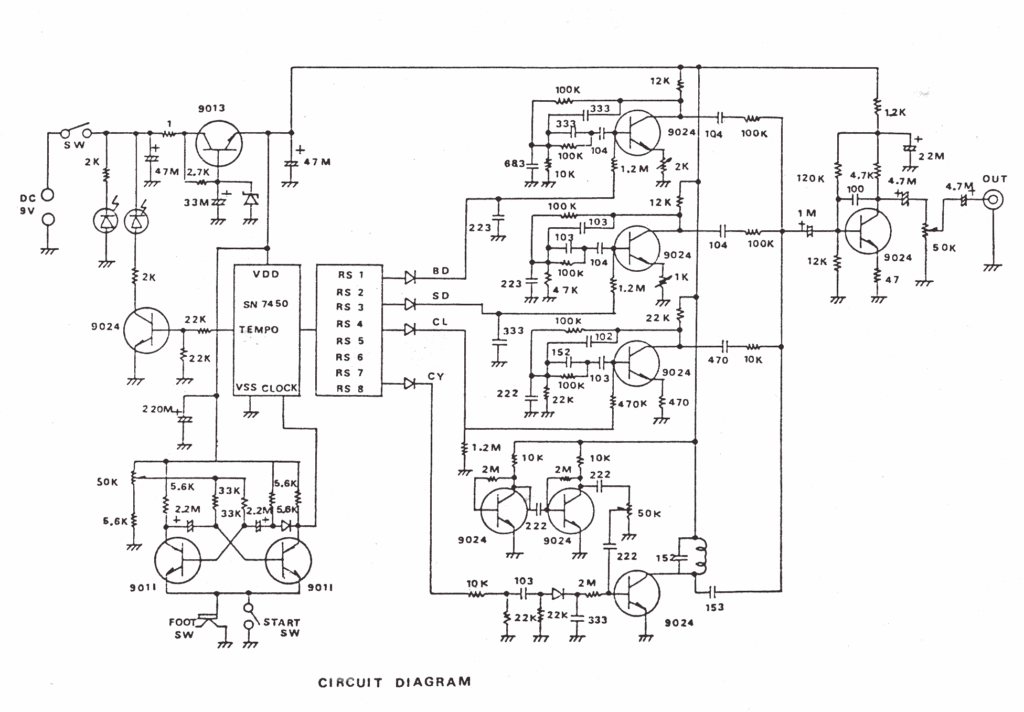
As suspected there is a master clock (a discrete astable multivibrator, towards the left/bottom) and some discrete Twin-T circuitry – the three transistors connected to BD (Bass Drum), SD (Snare Drum) and CL (Clave or woodblock). The circuit for the CY (Cymbal) is a little bit more involved, as it contains a noise generator that is gated via a transistor. The single connection between the SN74503 and an anonymous black box with RS1 to RS8 inside looks suspicious. The rhythm selection switches are nowhere to be found. Needless to say I have no IC labeled with SN7459, I just have a MCP4017.
That suggests we should take the whole circuit diagram with a sizable grain of salt, but if I squint my eyes in just the right way it matches my unit at least on a high level (and potentially on the sound-generation level).
Measuring & Injecting
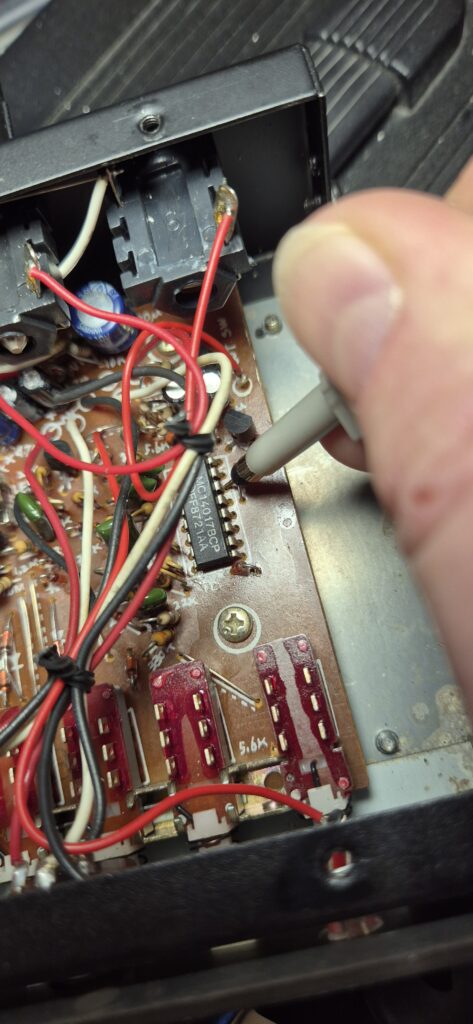
Since we now have a rough hint of what might be going on I decided this was a good moment to probe the circuit a bit. After finding a suitable 9V-power supply, removing the leaking battery, cleaning the battery compartment, double-checking the polarity of my power connector is right I went on to probe.
Unsurprisingly my initial suspicions proved right: As suspected the 4017 is used to divide down a faster clock and those new pulses are then used in a diode/resistor matrix together with the switches to create rhythms.
Probing the MCP40174 at the clock pin (see Fig.6) reveals it is operating at a logic level of 7.4 VDC (powered via a 9V power supply). This voltage can be lower or higher throughout the circuit to produce differently accented beats.
Probing around I quickly found some points near some diodes where I could inject my own rhythms using a function generator sending a positive pulse in a similar voltage to the one measured on the clock pin. It won’t surprise the reader that the length and magnitude of the pulse changes the resulting sound. This was to be expected since the Twin-T is a resonator meaning the voltage, shape and duration of the trigger is not insignificant.
Unfortunately I missed to accurately document these injection-points, but this doesn’t matter a lot since I planned to trace out the circuit anyways, since my drummer expected the new rhythms to be selectable via the old switches and I want to retain the existing sound generating circuits.
One the sound-side of the circuit three trimmable resistors. These appear to be mainly changing the feedback amount of the Twin-T resonators (thus also how long certain drum hits ring out). It could be nice to later move those controls out so the user can adjust them or maybe even control them via the microcontroller (e.g. using a digital potentiometer IC or some other form of voltage controlled resistor.
In the next part I plan to talk a little bit about what modifications I want to make and how those rhythms are gonna look like.
- AK-Drummer on Youtube: Video 1, Video 2 and some sound demos[↩]
- Originally from South Korea, the different brandings were used in different markets. The drum machine was sold under the labels AK-Drummer and Conrad in Germany[↩]
- users on the mailing list speculated that this is a specialized rhythm generation IC, but there is no real conclusive information[↩]
- see MCP4017 Decade Counter Datasheet[↩]
Leave a Reply