
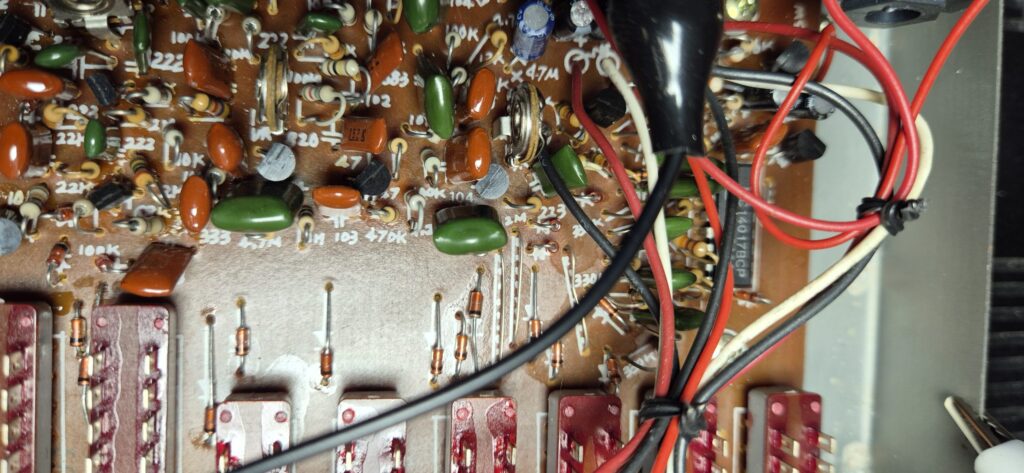
There are many different ways to mod a device. The first device I ever modded was my little brother’s toy keyboard, his only condition was that it “needs to work as normal”. The way I read this was that all the modifications should be reversible.
In this series the person who asked for the mod of this AK-Drummer CRM-260 is totally on board with a fundamental, reality-shifting modification, since he has a second unit that remains in its original condition. Since this little preset rhythm box isn’t exactly a rarity or highly sought after such a mod would also not represent a sin.
These means nearly everything is possible – however it does not mean everything is also a good idea. In this post I will try to outline some concepts that can be taken as a guide for what needs to be done.
circumstances & Goals
The originating urge behind the modification was to replace the “boring” preset rhythms with something more interesting. Now adjectives like boring and interesting are extremely subjective. Gladly the spin doctor behind this project is a known quantity to me as I am in a band with him for multiple years now. As much as this is a project to have some fun for me, the ultimate test is going to be how well it suits his idea of an instrument and how well I can judge what interesting constitutes. Well that and whether or how long it survives being handled by that man.
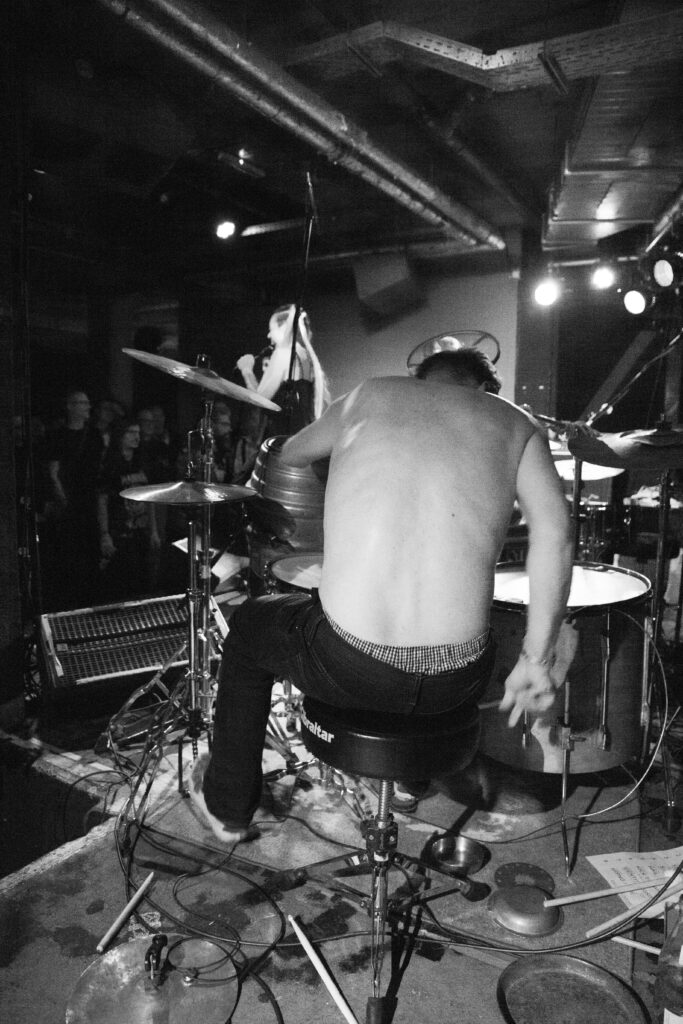
As an original punk that went over the years into ever more obscure music, my drummer (and the owner of the machine) certainly has some ideas about what interesting rhythms are made of. That includes qualities non-straight, polyrhythmic, unconventional, random, repetitive, subtle, brutal, static, evolving or otherwise simply weird rhythms. One of the features of the drum machine he likes most is the knob that allows speed changes on the fly without any fixed steps. Let’s call this a parameter, this word might get some meaning later in this post.
He also isn’t the most technical person, so any deep menus or complex features where you have to visualize a mental map of the devices internal workings and align a two-digit-number of stars the right way to get something interesting out is a guarantee for failure. The opposite of that is a completely straightforward experience much like the original, press a button, turn a knob and nevertheless nearly always get something out. The only problem is that the rhythms in the original rhythm machine are deeply limited. This calls for a more powerful concept.
A parametric rhythm source
As a modular synthesizer-person I already have multiple ideas how interesting rhythms could be brought into existence. My main idea is to not just use fixed presets, but to create a selection of parametric rhythm sources. Parametric in this context means that the rhythm isn’t stored somewhere in a fixed way until someone reprograms that drum hit to something else (like in a sequencer). No, parametric means that there is some algorithm that generates rhythms as we go derived from some variable parameters that the musician adjusts. These parameters are of course adjusted by rotating some dials and knobs, and have some abstract labels like Density or Chaos that change fundamental aspects of how the rhythms are constructed on the fly.
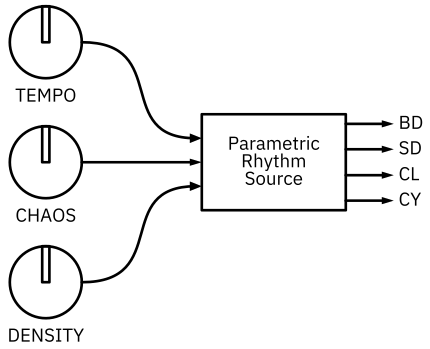
Needless to say this is a perfect match for a non-technical musician who is seeking for creative results: Direct control at the finger tips, a whole multidimensional parametric space to explore, practical musician-friendly abstractions that focus more on the resulting qualities and less on spreadsheet-like perfectionism.

Since the rhythm machine has eight preset buttons my idea is to create eight different parametric rhythm generators that can be selected by the press of a button. These won’t necessarily need to be eight fundamentally different algorithms, but can also be slight variations of a few selected algorithms, with different internal parameters and different rules how the knob values should be interpreted. Depending on the algorithm this can produce wildly different results.
The parameters (think: knobs) are inevitably tied to the physical hardware. That means if there are different algorithms they need to share a set of controls. But which controls? And how many? To answer these questions it probably makes sense to think about the algorithms first and then think about parameters to expose to in form of hardware.
Algorithmic idea 1: Relabi
I have learned about the concept of the Relabi Rhythm a while ago. This is an idea coined by John Berndt in his 2009 essay “Relabi”: Patterns of the Self-Erasing Pulse1. To paraphrase it, this is the idea of having an evolving wave that produces triggers whenever a certain absolute threshold is crossed. These triggers constitute a note being played or a drum being hit. As the wave changes the resulting triggers change.
The changing wave is what makes this special, in Berndts words:
A handful of networked, precisely tuned waved-based metronomes in the instruments accelerate and decelerate each other through a controlled feedback process, each one affected to a varying partial degree and passing its complex wave onto the next. Together they form something very vaguely comparable to a fractal or strange attractor, a complex low-frequency oscillator that generates a continuously re-inventing pattern full of overt self-similarity
The foundational idea of triggering events (or drum hits) based on threshold crossings is something that has been in use since computers or microcontrollers have timer interrupts (so at least since the late 50s)2.
I am not aiming to implement Relabi as a direct copy of what John Berndt has found for himself and shared with us, but the idea of using waves to trigger drums and thus getting a lot of variation out of a simple idea is intriguing and seems to me to be extremely flexible and worth exploring.
One could think about more complex triggering conditions, ways to create correlation (or the opposite) between the different tracks of the drum machine and since we are dealing with waves that are changing in real time, there are many parameters that can be exposed for the musician to play with.
Algorithmic Idea 2: Rotation
One very common method I use to generate drum rhythms on a modular synthesizer is to use a so called rotating clock divider. A clock divider is a device that has one input, many outputs and for each trigger on the input each output only outputs every nth pulse. So while output 1 passes each incoming trigger on, output 2 passes only every second pulse, output 3 only every third and so on. This is not entirely unsimilar to the way the 4017 IC in the AK-Drummer divides the clock into different beats that can then be combined using logic.
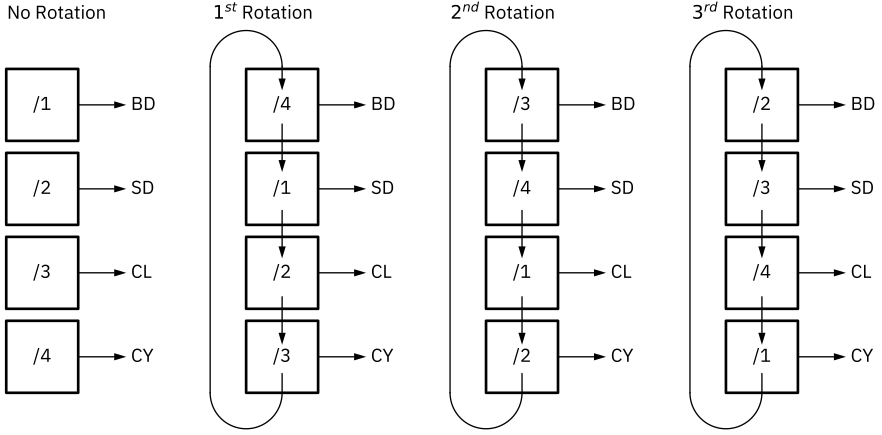
Now this was the “clock divider”-part, the rotating-part is what makes this special. Rotation means you can shift the output divisions around so output 6 suddenly “becomes” output 5 and so on. On a modular synth this shift can be introduced using a single control voltage. The shifted outputs still physically connect to the same logic and drum voices which is part of the appeal here: if before the rotation the cymbal was playing half notes notes, it may now just play triolic 8th notes, while the bass drum that was playing 16th notes before is now playing half notes etc.
As with the Relabi wave triggering the nature of the signal modifying the rotation parameter changes a lot about the resulting rhythms, it could be a wave or directly affected by the fingers of the musician.
Aside from the clock input clock dividers typically also have a Reset input that allows to reset everything back to the starting point, this is important if repetition or a certain length of pattern needs to be achieved. Randomizing these reset pulses can also give interesting results.
This concept of rotation can be extended far beyond clock division, for example it is simple to imagine a black box with  inputs and outputs, where in the middle is a host of complicated and fascinating effects, that affect (or don’t affect) each individual voice depending on how the kaleidoscope has been rotated. And you could have multiple of those blocks each with its rotation controlled by an individual wave. Definitely another extremely powerful concept.
Algorithmic Idea 3: Ludic Landscapes
Based on the notion of children game rules. I had the idea originally for experimental film making after reading the 1938 book Homo Ludens by the Dutch historian and cultural theorist Johan Huizinga3: To generate a new aesthetic one simply has to come up with a set of simple game-like rules, which in their complexity may generate some interesting emergent behavior. In a film that rule could be, that whenever the protagonist meets a certain person a certain thing has to happen, with the filmic figures still remaining autonomous.
If we move that concept to a rhythm machine, one could imagine evolving rulesets tied to different moment in time. For example a snare hit can only be played if a bass drum preceded it, but each time it is played it is being repeated one more time, the more snare hits are being played the higher the chance of a cymbal hit happening is. If the cymbal hit happens while the clave plays it needs to go to jail and collect 50 at the next start. You get the idea. Simulating some sort of game with more or less complex rules with each voice, and maybe even each “time slot” or each individual track or each individual hit being subjected to different rules.
These rulesets can be of course wildly different and variables within it can become parameters that either change over time or are affected directly by the musician. Another very powerful concept.
Taming the beast
Now all of the three ideas (wave triggering, rotation, rulesets) will likely result in some very chaotic non-repeating rhythms. This is not always desirable. Some form of repetition is good. Since the goal is to implement this on a microcontroller we are in control of time, at least the time of the simulation. That means we can expose the Duration of the rhythm as one of the parameters and potentially Mutation the speed at which the looping window shifts as another one.
Another common parameter I want to expose is Density. For this each virtually triggered drum hit is given a normalized intensity value (normalized means between 0.0 and 1.0). If the intensity of the hit is higher than the dialed in value for Density it triggers the sound. Otherwise it is ignored. This way the musician can quickly dial in the amount of drum hits that happen in the rhythm. Different modes could also use this in different ways, by for example removing clave and cymbals first, to then keep snare and bass drum right until the end.
Write drunken, edit sober
The above stated algorithmic ideas may all seem overly complex, but I am a firm believer one should not censor the craziness of ones ideas while they are happening, if the purpose is just to collect them. One can still tone them down a notch once they have to be put into hardware. Since this isn’t my first project of this kind, I think this is within the realm of the realistic for my own abilities still
Speaking of which.. In part 3 of this series I will talk about some hardware considerations regarding the modification.
- “Relabi”: Patterns of the Self-Erasing Pulse: see johnberndt.org[↩]
- In microcontrollers this method is usually used with a simple ramping wave as an input – this is commonly referred to as a Phasor). But any drum machine that wants to implement swing and uses a Phasor would likely add a simple sine wave on top of that Phasor[↩]
- Homo Ludens (1938) by Johan Huizinga: see Wikipedia[↩]
Leave a Reply